

Yes, photography is allowed, but flash near statues should be avoided and respectful behavior is expected.
Weather and seasonal access
Yes, it is open year round. However, the stone surfaces can be slippery after rain.
Visiting with family
Yes, the Vatadage can be visited by both children and older visitors. However, extra care is needed because the stone steps and platforms are uneven in some areas. Slow walking, proper footwear handling, and supervision for children are recommended.
Early morning and late afternoon are the best times due to softer light and cooler temperatures.
Most visitors spend 15 to 30 minutes, but slow travelers often stay longer.
Photography rules
Yes, photography is allowed, but flash near statues should be avoided and respectful behavior is expected.
Weather and seasonal access
Yes, it is open year round. However, the stone surfaces can be slippery after rain.
Visiting with family
Yes, the Vatadage can be visited by both children and older visitors. However, extra care is needed because the stone steps and platforms are uneven in some areas. Slow walking, proper footwear handling, and supervision for children are recommended.
Yes, it is included in the standard Polonnaruwa archaeological site ticket.
Yes, footwear must be removed before stepping onto the elevated stone platform.
Best time and duration
Early morning and late afternoon are the best times due to softer light and cooler temperatures.
Most visitors spend 15 to 30 minutes, but slow travelers often stay longer.
Photography rules
Yes, photography is allowed, but flash near statues should be avoided and respectful behavior is expected.
Weather and seasonal access
Yes, it is open year round. However, the stone surfaces can be slippery after rain.
Visiting with family
Yes, the Vatadage can be visited by both children and older visitors. However, extra care is needed because the stone steps and platforms are uneven in some areas. Slow walking, proper footwear handling, and supervision for children are recommended.
The Vatadage was built to protect and enshrine a sacred Buddhist relic. It served as a spiritual structure rather than a general temple.
Unlike large stupas and palace ruins, the Vatadage focuses on inward spiritual design with a circular layout and seated Buddha statues facing four directions.
Tickets and entry rules
Yes, it is included in the standard Polonnaruwa archaeological site ticket.
Yes, footwear must be removed before stepping onto the elevated stone platform.
Best time and duration
Early morning and late afternoon are the best times due to softer light and cooler temperatures.
Most visitors spend 15 to 30 minutes, but slow travelers often stay longer.
Photography rules
Yes, photography is allowed, but flash near statues should be avoided and respectful behavior is expected.
Weather and seasonal access
Yes, it is open year round. However, the stone surfaces can be slippery after rain.
Visiting with family
Yes, the Vatadage can be visited by both children and older visitors. However, extra care is needed because the stone steps and platforms are uneven in some areas. Slow walking, proper footwear handling, and supervision for children are recommended.
Polonnaruwa Vatadage is one of those places that stays with you long after you leave. I still remember the first time I walked across the ancient stone pathway toward its circular walls. The air felt heavy with history, yet calm in a way that is hard to explain. Unlike the grand stupas that rise sharply into the sky, this structure draws you inward instead of upward. Step by step, it invites you closer without trying to impress.
Set at the heart of the Sacred Quadrangle, this monument carries centuries of devotion, art, and royal purpose. What makes it special is not only its age or its stone carvings, but also the feeling that life once moved slowly and with intention here. Monks once walked these same paths. Kings once stood where travelers pause today. Over time, layers of human presence settled quietly into the stone.
To explore the quieter side of the ancient city beyond the circular shrine and main ruins, this guide reveals many lesser-known locations in Hidden Places in Polonnaruwa You Should Not Miss.
Many visitors reach Polonnaruwa with a checklist in hand. They rush from ruin to ruin, trying to cover everything before the sun sets. The Vatadage asks for a different rhythm. It rewards those who slow their pace. Light changes the mood of the carvings as the day moves on. A soft breeze passes through the open structure. Sometimes, the silence itself becomes the most powerful part of the visit.
To better understand how this sacred monument fits within the wider ancient city layout, this detailed Polonnaruwa travel map for major attractions offers a clear spatial overview.
Why this monument feels different from other ruins
In this guide, I will walk you through the deeper story behind this ancient monument. You will learn how it was built, why it mattered so deeply to the kings of Polonnaruwa, and how you can experience it today in a meaningful way. Along the way, I will also share practical tips, personal observations, and small details that often go unnoticed.
When you finally stand inside the circular stone walls and look at the seated Buddha figures facing each direction, something subtle often happens. The Vatadage does not feel like a ruin that has lost its purpose. Instead, it feels like a space that still remembers why it exists. That quiet sense of continuity is what makes this place truly unforgettable.
The historical roots of Polonnaruwa Vatadage
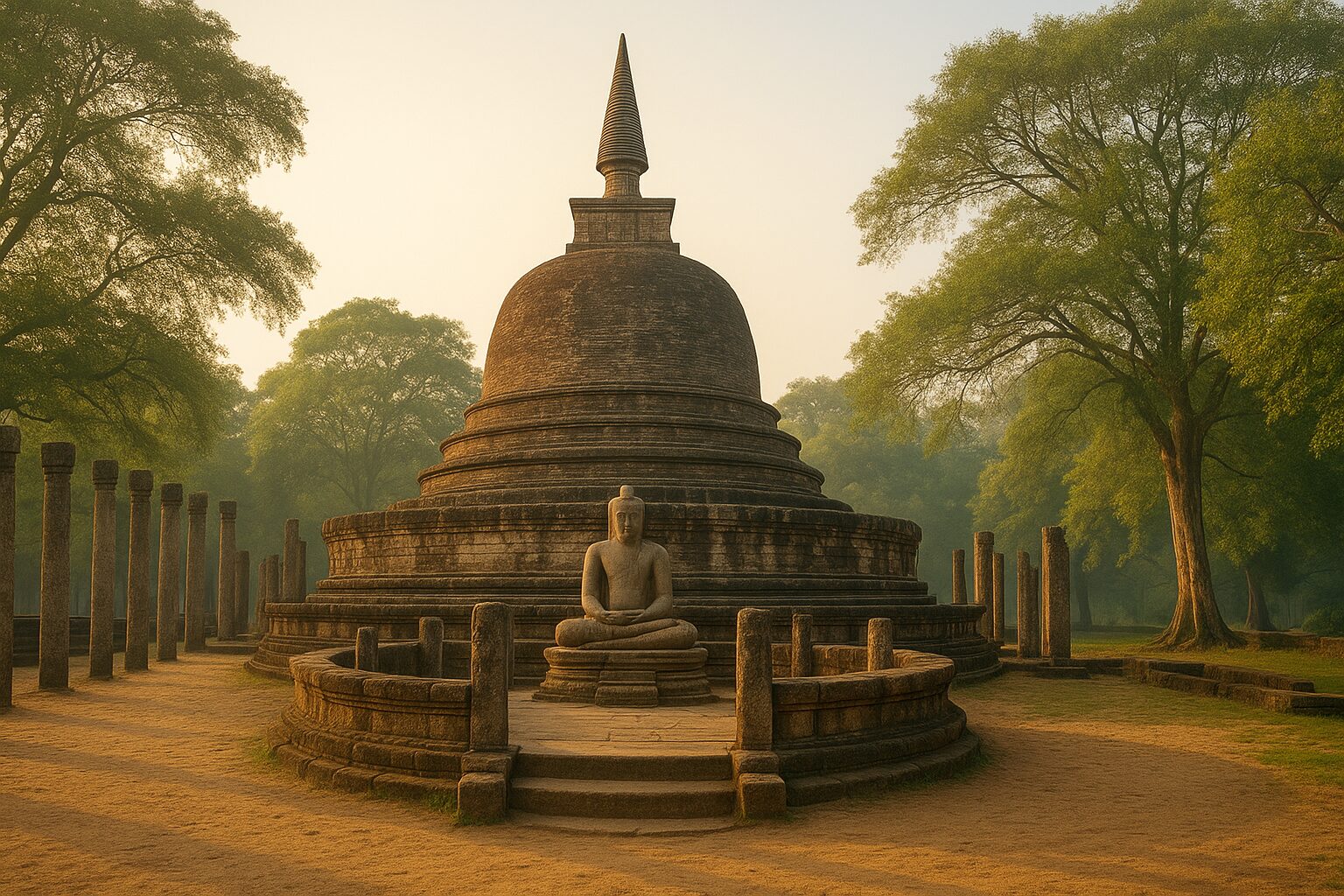
Polonnaruwa as Sri Lanka’s medieval capital
Understanding the Polonnaruwa Vatadage becomes much easier when you place it inside the wider story of Sri Lanka’s medieval capital. After the decline of Anuradhapura, Polonnaruwa rose to power around the 11th century. This was not only a political change. It marked a turning point in irrigation, architecture, and religious life across the island.
Massive reservoirs were built. Agriculture flourished. Religious institutions grew stronger. Polonnaruwa became a city shaped by both administrative vision and spiritual devotion. The Vatadage emerged during this period as a symbol of that balance.
The kings behind the Vatadage
The Vatadage is believed to have been constructed during the reign of King Parakramabahu the Great and later refined under King Nissanka Malla. Both rulers were deeply devoted to Buddhism, yet each expressed that devotion in different ways.
Parakramabahu focused on unifying the Buddhist order and strengthening the kingdom through irrigation and governance. Nissanka Malla, on the other hand, is remembered for his active role in building monuments that reflected both faith and royal authority. Within this environment, the Vatadage took shape as a structure that blended spiritual significance with royal intention.
Why the Vatadage was built
Unlike towering stupas that dominate the skyline, a vatadage served a more intimate and sacred purpose. It was built to house a relic of the Buddha, believed during certain periods to be a tooth relic. Because of the relic’s importance, the structure was designed to protect and honor something considered spiritually priceless.
This is why the builders created a raised circular platform surrounded by stone pillars and guarded by carefully carved entrances. Every element served both a symbolic and protective role.
Survival through centuries of change
Over time, invasions, shifting capitals, and neglect took their toll on Polonnaruwa. Forests crept inward. Stone collapsed. Relief carvings softened under wind and rain. Yet, the Vatadage endured better than many other monuments. Its balanced design and strong stone foundations allowed it to survive centuries of abandonment.
When British explorers and archaeologists later rediscovered Polonnaruwa in the 19th century, the Vatadage immediately stood out. Even in ruin, its symmetry, moonstones, and seated Buddha statues revealed exceptional craftsmanship. Restoration followed, not to rebuild it into something new, but to stabilize what remained and preserve its original form.
Today, when you walk through the Sacred Quadrangle and step onto the stone platform of the Vatadage, you are not just seeing a preserved ruin. You are standing at the meeting point of royal ambition, spiritual devotion, and timeless artistry. The structure still carries the quiet story of a kingdom that once ruled with both strength and faith.
Architectural design and layout of the Vatadage

At first glance, the structure appears simple. A circular stone platform. Four stairways. Rows of pillars. Yet, the longer you observe it, the more intentional every detail begins to feel. Nothing here exists by accident. The design guides the visitor gently from the outside world into a sacred inner space.
The entire monument is built on a raised circular terrace. This elevation was not only symbolic but also practical. It protected the inner relic chamber from moisture while creating a sense of entering something spiritually higher. As you climb the steps, the noise from outside slowly fades. Even with tourists nearby, the space somehow feels contained.
The four cardinal entrances and their symbolism
Each entrance to the Vatadage faces one of the four cardinal directions. This was not just for symmetry. In Buddhist architecture, direction holds meaning. The four entrances allowed devotees from all paths to approach the relic with equal respect. No single direction was considered greater than the others.
The stairways are guarded by beautifully carved stone features. First comes the outer moonstone. Then the guarding stones. Finally, the balustrades shaped like mythical creatures. Each layer marks a transition. You are not just walking upward. You are moving symbolically from the ordinary world into a sacred space.
What struck me personally was how worn the steps felt underfoot. That smoothness did not come from time alone. It came from countless human footsteps. Pilgrims. Monks. Kings. Traders. All climbing these same stones with different intentions, yet arriving at the same center.
Inner stone circle and seated Buddha statues
Inside the outer wall stands a second, smaller stone circle. This inner boundary protected the most sacred area where the relic was enshrined. Within this space sit four seated Buddha statues, each facing one of the entrances.
Although time has damaged parts of these figures, their calm expressions remain powerful. Each statue radiates a quiet stillness that feels untouched by centuries of weather and human movement. Even on busy days, visitors tend to lower their voices here without being told to do so.
The positioning of these Buddha images facing outward is deeply symbolic. It represents the Buddha watching over all directions of the kingdom. In a way, it also reflects the idea that the Dhamma spreads outward to all corners of the world.
Pillars, roof structure, and lost upper chamber
The ring of stone pillars surrounding the inner chamber once supported a wooden roof. Today, only the stone remains. The roof itself has long vanished. Still, the height and placement of the pillars allow you to imagine how the structure once felt enclosed above.
Scholars believe an upper chamber once existed, possibly housing the sacred relic itself. Over time, that upper structure collapsed or was dismantled. What remains now is the foundation of that sacred geometry.
Standing beneath the open sky, it is easy to forget that this place was once roofed. Yet, there is something fitting about the openness today. Light pours in freely. Shadows move slowly across the stone. The monument feels alive in a new way, shaped as much by time as by human hands.
Art, carvings, and stone craftsmanship

What often surprises people about the Polonnaruwa Vatadage is how much emotion and storytelling exist within its stone. From a distance, it looks calm and restrained. Up close, however, every carved surface reveals a layer of quiet creativity and skill that goes far beyond simple decoration.
The artisans who worked here were not only builders. They were also storytellers. Without written explanations, they used stone to communicate beliefs, protection, movement, and harmony. Each curve and line serves a purpose, even if that purpose is now partly lost to time.
The moonstones and their layered symbolism
At the base of each staircase lies a moonstone, one of the most distinctive features of ancient Sri Lankan architecture. Unlike the more elaborate moonstones found in Anuradhapura, the ones at the Vatadage feel more restrained. Still, their symbolism remains deep.
Traditionally, these carvings represent the cycle of samsara, the endless loop of birth, suffering, and rebirth. Animals move in rhythm around the edge. Floral designs follow. Finally, a central lotus appears at the heart. This lotus stands for spiritual awakening and release from suffering.
When I stood over one of these moonstones early in the morning, the carvings caught the side light beautifully. The shallow shadows made the patterns come alive in a subtle way. It was a reminder that these details were never meant to be rushed past.
Guard stones and balustrades at the entrances
Just beyond the moonstones stand the guard stones. These figures appear calm yet alert. Their role was symbolic protection. They welcomed devotees while also standing watch over the sacred interior.
The balustrades curve upward beside the stairways. Often shaped like mythical creatures, they represent the transition between the earthly and the spiritual. These carvings feel almost fluid despite being made from solid stone. There is movement frozen in their forms.
What makes these entrance elements special is their balance. None of the carvings feel aggressive or overpowering. Instead, they create a gentle sense of boundary. You feel guided inward rather than warned away.
Stone pillars and surface textures
The tall stone pillars surrounding the inner platform may look plain at first. Look closer and you will notice subtle variations in texture and finish. Some surfaces remain smooth from repeated touch. Others still show the faint marks of ancient tools.
These pillars once supported a wooden roof, yet even without it, they continue to define the space. Their rhythm around the circle creates a quiet sense of order. Walking between them feels almost like moving through a living arrangement of time.
What stayed with me most was the feel of the stone itself. Warm under midday sun. Cool in the early morning. The surface carries the memory of centuries of weather and worship.
Together, these artistic elements do not shout for attention. Instead, they speak slowly. The longer you remain inside the Vatadage, the more these quiet details begin to shape your experience.
Religious importance and spiritual atmosphere
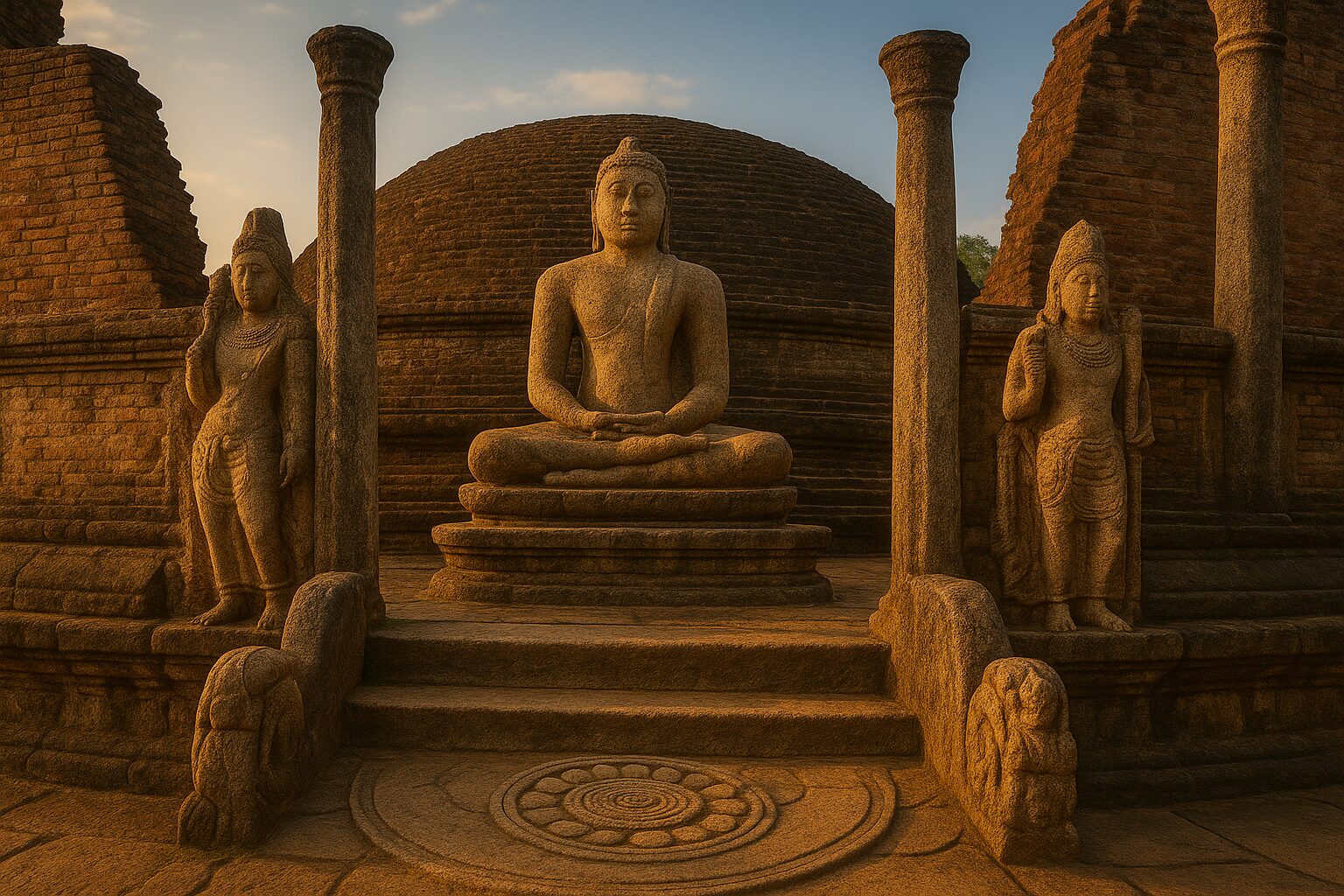
Beyond stones, carvings, and symmetry, the true heart of the Polonnaruwa Vatadage lies in its spiritual purpose. This structure was never meant to impress through size. Instead, it was created to protect something sacred and to offer a space where devotion could unfold quietly.
For centuries, this was a place where relic worship took place. The relic housed here, believed to have been sacred to the Buddha himself, transformed this monument into more than a royal construction. It became a living spiritual center. People did not come merely to admire architecture. They came to bow, to offer flowers, and to reflect.
Even today, long after the relic has moved elsewhere, that sense of reverence still lingers. Visitors naturally slow their pace as they step inside. Voices drop. Movements soften. There is no sign asking for silence, yet silence often appears on its own.
The role of the Vatadage in Buddhist worship
In ancient Sri Lanka, relics were not simply religious objects. They were symbols of legitimacy, protection, and the living presence of the Buddha. A Vatadage served as the protective enclosure for such relics. It was a sacred container rather than a grand display.
Rituals here would have included offerings of flowers, oil lamps, incense, and chants. Monks and laypeople alike gathered around the inner chamber. The circular layout encouraged movement around the relic, reinforcing the idea of continuous devotion rather than one fixed viewpoint.
This circular movement is something you can still feel today. Many visitors find themselves instinctively walking around the inner platform before stopping. The design gently teaches you how to move within the space.
How the atmosphere feels today
What surprised me during my visits was how different the Vatadage felt at different times of day. Early mornings often feel meditative. The light is soft. Birds move between the pillars. Fewer people are around.
By midday, the space becomes brighter and warmer. Travelers arrive in small groups. Cameras click softly. Even then, the monument holds its calm in a quiet way. It never feels overwhelmed.
In the late afternoon, shadows stretch across the platform. The seated Buddha statues seem to change expression as the light shifts across their faces. This is when the place feels most reflective to me. The day slows down. The heat fades. The stone cools.
Despite being one of the most visited spots in Polonnaruwa, the Vatadage has managed to preserve a gentle spiritual presence. It does not demand reverence. It simply invites it.
Visiting Polonnaruwa Vatadage today

Experiencing the Polonnaruwa Vatadage in person feels very different from seeing it in photos. The monument is not isolated. It sits within the Sacred Quadrangle, surrounded by some of the most important ruins in the ancient city. Because of this, your visit naturally becomes part of a wider historical walk.
Explore Vatadage on Google Maps
The approach itself builds anticipation. As you move through the stone pathways of the quadrangle, the circular shape of the Vatadage slowly reveals itself. There is something grounding about finally stepping onto the raised platform after seeing it from a distance.
If you are planning a full day around this ancient site, this complete Polonnaruwa Sri Lanka travel guide will help you explore not only the Vatadage but also nearby ruins, local food stops, cycling routes, and practical visitor tips for the entire heritage city.
Entrance tickets and access information
The Vatadage does not have a separate ticket of its own. Instead, it is included within the main Polonnaruwa archaeological site entrance pass. This single ticket allows you to explore the entire ancient city, including the Sacred Quadrangle, Royal Palace, and other major ruins.
Tickets are usually purchased at the main Polonnaruwa Archaeological Site entrance. You will need to show your passport when buying the ticket. Prices can change over time, especially for foreign visitors, so it is always wise to check the latest rates before your trip.
Once inside the site, reaching the Vatadage is easy. Most visitors either cycle or use a tuk tuk to move between locations. The Sacred Quadrangle is well marked, and local drivers are very familiar with the route.
Opening hours and best time to enter
The Vatadage follows the general opening hours of the Polonnaruwa archaeological complex, which typically opens early in the morning and closes by early evening.
In my experience, the best time to visit is early morning, just after opening. The air feels fresher. The light is softer. You can explore with fewer people around you. Late afternoon is also a beautiful time, especially for photography and calm reflection.
Midday visits are still rewarding, but the heat can be intense, especially during the dry season. Shade is limited around the platform, so plan accordingly.
Dress code and visitor behavior
Since the Vatadage is a sacred Buddhist site, respectful clothing is expected. Shoulders and knees should be covered. Shoes must be removed before stepping onto the elevated platform. There is usually a designated area near the entrance where visitors leave their footwear.
Silence is not enforced by rule, yet most people naturally lower their voices. Touching statues or climbing on ruins is not allowed. These structures are fragile and deeply meaningful to many.
One small but important tip is to carry your footwear in a bag rather than leaving it unattended during crowded times. This helps avoid confusion later on.
Visiting the Vatadage is not a rushed experience. Even a short stay tends to feel meaningful when you allow yourself to slow down and observe quietly.
How Polonnaruwa Vatadage fits into your wider site exploration

One of the most beautiful things about the Polonnaruwa Vatadage is how naturally it connects with the surrounding ruins. It does not stand alone as a single attraction. Instead, it feels like the calm center of a much larger historical story unfolding all around you.
Most visitors reach the Vatadage while exploring the Sacred Quadrangle. This compact area holds an extraordinary concentration of monuments, all within easy walking distance. Because of this, your experience of the Vatadage often becomes deeper when viewed alongside its neighbors.
Connection with the Royal Palace and council chambers
Just a short walk away lies the Royal Palace of King Parakramabahu. While the Vatadage reflects spiritual devotion, the palace speaks of royal power and daily governance. Moving between the two creates a strong contrast. In one moment, you stand in a space of meditation. In the next, you walk through massive stone walls that once echoed with courtly life.
Seeing both on the same day helps you understand how closely religion and leadership were linked in ancient Polonnaruwa. Kings were not only rulers. They were also protectors of faith.
Link between the Vatadage and Gal Vihara
Gal Vihara sits slightly further away but remains deeply connected in meaning. The serene rock-cut Buddha statues there carry the same quiet dignity you feel at the Vatadage. Many visitors notice that after seeing the seated Buddha figures at the Vatadage, the standing and reclining figures at Gal Vihara feel even more powerful.
I often suggest visiting the Vatadage first, then moving on to Gal Vihara. The transition feels natural. One prepares the mind. The other deepens the emotional impact.
Cycling routes and walking paths around the Quadrangle
If you are exploring Polonnaruwa by bicycle, the Vatadage makes an ideal stopping point. Bike paths around the Sacred Quadrangle are flat and manageable. You can lock your bicycle nearby and walk in barefoot with ease.
Walking between sites also allows you to notice small details that vehicles tend to skip. Stone markers. Shaded trees. Local vendors resting by the roadside. These quiet moments bring balance to the larger monuments.
By planning your route thoughtfully, the Vatadage becomes more than a single stop. It becomes the emotional anchor of your Polonnaruwa journey.
Practical travel tips for a smoother visit

By the time most travelers reach the Polonnaruwa Vatadage, they have already spent a few hours walking or cycling through ruins. Fatigue often sneaks in quietly. A little preparation makes a big difference in how deeply you can enjoy this part of the site.
One thing I learned quickly is that hydration matters more than you think here. The stone platform reflects heat upward, especially between late morning and early afternoon. Carrying enough water is not optional. Small shops near the main road sell bottles, but they are spaced far apart. It helps to buy water before you enter the Sacred Quadrangle.
Footwear is another detail that sounds simple but becomes important at the Vatadage. Since shoes must be removed, sandals or flip-flops make life easier than tightly laced trainers. The stone can be warm underfoot. During peak heat, the surface sometimes feels almost hot. Early visits avoid this problem entirely.
A hat or umbrella offers more value than many expect. Shade around the platform is limited. Standing inside the inner circle gives brief relief, but most of the time you remain exposed to the sun.
If you are sensitive to heat, plan shorter stops instead of lingering too long in one exposed spot. You can always return later in the day when the temperature drops.
Dealing with crowds without losing the experience
The Vatadage is one of the most photographed spots in Polonnaruwa. Tour groups arrive in waves. When they do, the quiet atmosphere changes quickly.
What works best is patience. Instead of pushing through, step slightly aside and wait a few minutes. Groups move on faster than you might expect. Once they leave, the space often becomes calm again.
Another option is to reverse the usual route. Many guides follow the same direction through the quadrangle. If you walk against that flow, you often reach the Vatadage when fewer people are present.
Simple things to carry with you
A few small items make the visit more comfortable:
-
A light cotton cloth for covering shoulders or knees if needed
-
A reusable water bottle
-
Sunscreen
-
A small bag for carrying footwear
-
Wet wipes or tissues
None of these feel essential until you suddenly need them. Once you do, you become very grateful you packed lightly but wisely.
Capturing the Vatadage through photography

Photographing the Polonnaruwa Vatadage is both rewarding and surprisingly challenging. The structure looks simple from afar, yet its mood shifts constantly with light, shadow, and movement. What you capture depends less on your camera and more on your patience.
Early morning offers the softest light. The stone takes on a gentle glow, and the carvings gain depth without harsh contrast. If you arrive just after opening time, you can often walk around the platform without people stepping into every frame. This is when wide-angle shots work best, allowing the full circular form to breathe within the image.
Travelers planning early visits often benefit from nearby stays, and this guide to hotels and guesthouses in Polonnaruwa helps choose accommodation close to the Ancient City.
Midday light is harsher. Shadows fall shorter. The texture of the stone becomes sharper, but emotions fade from the frame. Still, this can be a good time to focus on close-up details. Moonstones, guard stones, and the subtle lines on the pillars show clearly under strong light.
Late afternoon is where the magic returns. Long shadows stretch across the platform. The seated Buddha statues change character almost minute by minute as the sun moves lower. This is the time when even a mobile phone camera can produce deeply atmospheric images.
One thing I learned the slow way is to take time before pressing the shutter. Walk around once without shooting. Notice where light falls. Listen to how the space feels. Then start capturing. When photography becomes rushed, the soul of the place disappears from the frame.
Respectful photography inside a sacred space
Even though this is a popular attraction, it remains a religious site for many visitors. Avoid climbing onto stones for angles. Do not block people who are quietly paying respects. Flash photography near the statues is best avoided.
If you photograph people, try to include them naturally without turning the site into a backdrop for poses that feel out of place. Sometimes a distant silhouette tells a better story than a close-up portrait.
Photography here works best when it follows the rhythm of the site rather than trying to control it.
Common mistakes visitors often make at the Vatadage

Even though the Polonnaruwa Vatadage appears calm and easy to explore, small mistakes can quietly take away from the experience. Most of these do not come from bad intentions. They happen because people arrive unprepared or rush without fully understanding where they are.
One of the most frequent mistakes is treating the Vatadage like a quick photo stop. Many visitors arrive with a tight schedule and give themselves only a few minutes here. They walk in, take a wide shot, and move on. What gets lost is the layered atmosphere. The site reveals its depth slowly, not instantly.
Another issue is visiting during the hottest part of the day without planning for it. The stone platform absorbs heat and reflects it back. When the sun stands directly overhead, even a short stay can feel draining. Discomfort quickly replaces curiosity.
Footwear confusion and rushed movement
Shoes must be removed before stepping onto the inner platform. Some visitors arrive wearing shoes that are difficult to remove quickly. This leads to hurried movements, frustration, and sometimes stepping onto stone with socks that slip easily.
A slow, mindful entry changes everything. When visitors pause, remove footwear calmly, and step barefoot onto the stone, the experience naturally becomes more meaningful.
Ignoring the wider context of the Sacred Quadrangle
The Vatadage makes the most sense when seen as part of the Sacred Quadrangle rather than as a standalone monument. Some travelers arrive directly here without understanding what surrounds it. As a result, they miss how closely its spiritual role connects to nearby structures.
Taking even a short walk around the quadrangle before or after your visit deepens your understanding of the site’s purpose within ancient Polonnaruwa.
Overposing and performative photography
Another common mistake is turning the sacred space into a stage. Loud posing, repeated jumping, or climbing for photos disrupts the quiet mood not only for yourself but for others as well.
The best images from the Vatadage often come when photographers blend into the space rather than trying to dominate it.
Avoiding these small missteps allows the monument to speak on its own terms. When that happens, the visit feels richer without requiring extra effort.
Just a short walk from the Vatadage, the stone-built shrine of Shiva Devalaya Polonnaruwa highlights the rare Hindu presence within the Sacred Quadrangle.
What visitors say on TripAdvisor
Another vatadage that I really liked and impressed me especially for its configuration and its story. Recommendation a thorough visit and you will love it too.
Read more reviews on Tripadvisor
This is located near by Polonaruwa, starred dating back to over 2000 years and sprayed over 100 acres. Other main feature of Monastery is a hospital that was quite advanced.
Read more reviews on Tripadvisor
Read more on Tripadvisor
Cultural sensitivity and local etiquette to keep in mind

The Polonnaruwa Vatadage may appear to many travelers as an ancient ruin, yet for locals it remains a living symbol of faith and heritage. Approaching the site with cultural awareness changes the tone of your visit in a quiet but powerful way.
One of the simplest signs of respect is body language. Walking calmly, keeping voices low, and avoiding exaggerated gestures all help preserve the atmosphere. Even when the site feels busy, your personal approach still shapes your own experience.
Pointing feet directly toward Buddha statues while sitting is considered disrespectful in local Buddhist culture. If you choose to sit for a moment inside the platform area, try to sit sideways or cross-legged with awareness of where your feet rest.
Clothing beyond the basic dress code
Covering shoulders and knees is the basic rule, but sensitivity goes a little further than that. Clothing that is too tight, transparent, or decorated with bold slogans can feel out of place in sacred spaces. Light, modest clothing not only respects tradition but also feels more comfortable in the heat.
Carrying a simple shawl or scarf makes it easy to adjust your clothing before stepping onto the stone platform. Many travelers who forget this end up feeling rushed or self-conscious.
Behavior around worshippers
Although many visitors come primarily to explore history, some still arrive to offer flowers or spend time in quiet reflection. These moments deserve space. Avoid walking directly in front of someone who is praying. Try not to stand over people while they kneel.
If you watch quietly from a short distance, you gain a deeper sense of how the site continues to live beyond tourism.
Cultural sensitivity here does not require strict rules or pressure. It simply asks for a bit of awareness. When that awareness is present, the Vatadage feels less like a monument and more like a shared human space across time.
Nearby places that pair beautifully with a Vatadage visit

One of the quiet joys of exploring the Polonnaruwa Vatadage is how naturally it fits into a broader flow of nearby sites. You do not need to rush or plan complicated routes. Several meaningful places sit just minutes away, and each one adds a different layer to the story you are already stepping into.
Just a short distance from the Vatadage, the magnificent rock-cut Buddha statues at Gal Vihara offer one of the most peaceful and visually powerful experiences in the ancient city.
Satmahal Prasada and the mystery of its design
Not far from the Vatadage stands Satmahal Prasada, a unique seven tiered structure that still puzzles archaeologists. Unlike most buildings in Polonnaruwa, its design does not clearly match typical Sri Lankan architectural patterns. Some suggest South Indian influence. Others see similarities to Southeast Asian styles.
After spending time inside the stillness of the Vatadage, walking to Satmahal Prasada feels like entering a place of unanswered questions. The contrast between clear spiritual purpose and architectural mystery creates an interesting mental shift.
Hatadage and Atadage relic houses
Very close to the Vatadage are the Hatadage and Atadage, two ancient relic houses that once also sheltered sacred objects. Visiting them right after the Vatadage strengthens your understanding of how central relic worship was to this part of the city.
Hatadage sits low and peaceful, often overlooked by hurried travelers. Atadage, though partly ruined, carries a heavier atmosphere. Together with the Vatadage, they form a quiet triangle of devotion within the Sacred Quadrangle.
Kiri Vehera for a wider spiritual perspective
If you move slightly beyond the quadrangle, Kiri Vehera offers a very different visual experience. Its white stupa rises cleanly against the sky. While the Vatadage draws you inward, Kiri Vehera opens your gaze upward.
Many visitors feel a natural emotional shift between these two spaces. One invites quiet inner reflection. The other encourages outward awe. Together, they balance each other well within the same day of exploration.
Pairing the Vatadage with even two or three of these nearby sites creates a circular journey of meaning rather than a checklist of ruins. Just a short walk from the Vatadage, the peaceful white stupa of Kiri Vehera Polonnaruwa offers a quiet space for reflection within the ancient sacred zone.
Just a short distance from the Vatadage, the ancient administrative center of the kingdom can still be explored at the Royal Palace Polonnaruwa, where massive stone pillars reveal the scale of King Parakramabahu’s rule.
Just behind Vatadage lies the enclosed brick shrine of the Lankathilaka Image House Polonnaruwa, where travelers can experience a quieter and more reflective sacred space within the Sacred Quadrangle.
Just beyond the Vatadage complex, you can continue your sacred walk to Rankoth Vehera Polonnaruwa, one of the largest and most spiritually important stupas in the ancient city.
Food and rest spots near the Vatadage

After walking barefoot on warm stone and moving slowly through centuries of history, the body eventually asks for rest. Fortunately, the area around the Sacred Quadrangle offers a few simple but satisfying options to pause, cool down, and recharge.
Most small eateries sit slightly outside the main archaeological zone. They are easy to reach by bicycle or tuk tuk within a few minutes. These places do not look fancy, yet the food often feels exactly right after hours under the sun.
Simple local meals that feel rewarding
Rice and curry is the most common choice, and for good reason. A plate usually comes with several small vegetable curries, sambol, papadam, and rice. The flavors are bold but comforting. After a long walk, it feels grounding rather than heavy.
Hoppers, roti, and dhal curry are also easy to find. If you prefer something light, a fresh fruit plate with papaya, pineapple, and banana works surprisingly well in the heat. Curd and treacle is another simple option that cools the body and energy at the same time.
Cafes and quiet resting points
A few guesthouses and small cafes around Polonnaruwa town offer shaded seating, cold drinks, and basic Western food. These places feel calm compared to the busier tourist belts in other heritage cities. Cold fruit juice or plain king coconut water often feels better than any soft drink here.
What matters most is not the menu but the pause itself. Sitting down, removing dust from your hands, and letting your feet recover for fifteen quiet minutes can completely change how you experience the rest of the day.
Timing your rest wisely
If possible, take your main break during the harsh midday heat. Visit the Vatadage and Quadrangle either early in the morning or later in the afternoon. This way, you avoid rushing sacred spaces simply because the sun feels unbearable.
Rest, here, becomes part of the journey rather than a break from it. When done gently, it allows you to return to the ruins with a clearer mind and lighter body.
Safety, weather, and seasonal advice for your visit

Polonnaruwa is a gentle destination in many ways, yet the climate and surroundings still deserve thoughtful planning. The Vatadage itself is calm and well maintained, but your comfort and safety depend largely on timing and awareness.
Weather patterns and the best seasons to visit
The dry season from May to September is generally the most comfortable time to explore the site. Skies stay clear, and rain rarely interrupts long walks. However, this is also when temperatures climb higher, especially around midday.
October to January brings the northeast monsoon. Rain becomes more frequent, though it usually falls in short bursts rather than all day. The upside is that the surrounding greenery becomes lush, and the air often feels fresher. Stone surfaces may feel slippery after rain, so extra care is needed when walking barefoot.
February to April is hot and dry again, with April often being the warmest month. During this period, early morning and late afternoon visits feel far more manageable than midday exploration.
Sun exposure and heat awareness
The Vatadage platform offers little natural shade. Long exposure under direct sun can lead to dehydration or dizziness if you are not careful. Wearing a hat, applying sunscreen, and carrying water becomes especially important during hotter months.
If you begin to feel lightheaded, step away from the stone platform and rest under nearby trees inside the Quadrangle. The body often recovers quickly with water and a few minutes of shade.
General safety around the site
Polonnaruwa is considered a safe area for travelers. Serious crime against tourists is rare. Still, basic common sense goes a long way. Keep your valuables secured. Do not leave bags unattended, especially during busy hours.
Stray dogs sometimes wander through the ruins. Most are calm and uninterested in visitors. Simply avoid direct interaction and move slowly around them.
Cyclists should remain alert when sharing narrow paths with tuk tuks and tour vehicles. Movement inside the ancient city is slow, but awareness prevents small accidents.
When approached with patience and respect, the Vatadage offers a safe and gentle environment that welcomes both quiet reflection and curious exploration.
A personal reflection on slow travel at the Vatadage
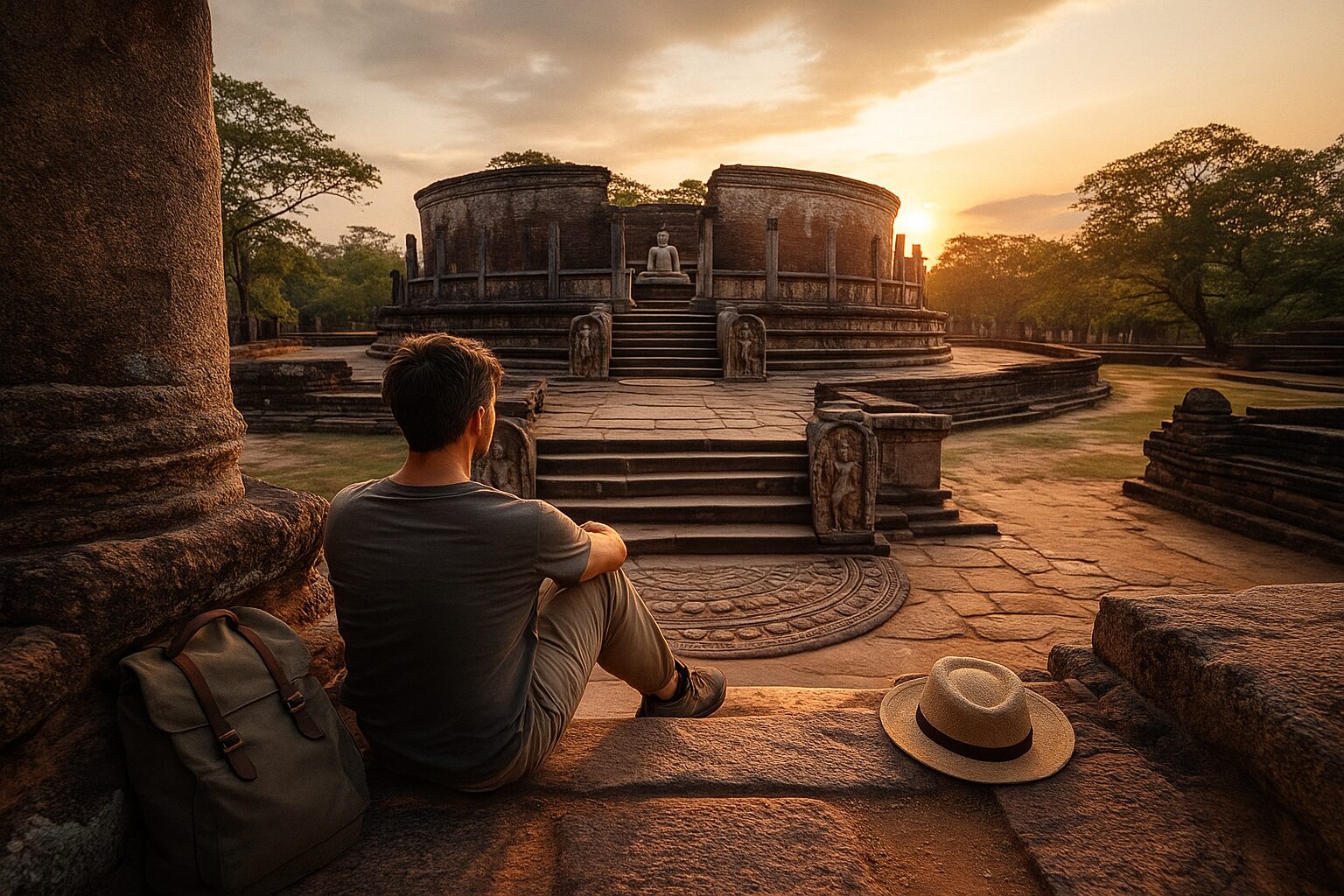
Out of all the places I have visited in Polonnaruwa, the Vatadage is the one that taught me the most about slowing down without forcing it. Some locations demand your attention with size or noise. This one does the opposite. It softens your pace without asking.
On my first visit, I walked in expecting to stay for a few minutes. That plan quietly disappeared. I found myself circling the inner platform more than once, not for photos, but simply because the space felt balanced. There was no rush coming from the monument itself. Only my own schedule tried to interrupt.
What stayed with me most was how the place felt between moments. Between footsteps, camera clicks and voices drifting in and out. In those pauses, the Vatadage felt less like a historical site and more like a shared human memory that had never fully left.
Slow travel often sounds like a trend. Here, it feels natural. You do not need to plan for it. The space invites it on its own terms.
I also noticed how different people responded to the place. Some sat quietly. Others walked slowly with folded hands. A few simply stood and watched the light move across stone. Everyone seemed to find their own rhythm without being told what to feel.
That, to me, is the quiet gift of the Vatadage. It does not instruct. It allows. And in allowing, it teaches without saying much at all.
Final thoughts and meaningful visitor takeaways
By the time most visitors leave the Polonnaruwa Vatadage, they carry more than just photos with them. Something quieter tends to follow along. It might be a feeling of calm. It might be a sense of humility. For some, it is simply the memory of warm stone beneath bare feet and open sky above.
What makes this place special is not only its age or beauty. It is how gently it holds both. The structure does not overwhelm you. It does not compete for attention. Instead, it stays steady and patient, allowing each person to meet it in their own way.
For travelers who move fast, the Vatadage becomes a reminder to pause. For those who already move slowly, it feels like quiet confirmation that there is value in that pace. It does not matter whether you arrive with deep knowledge of Sri Lankan history or only surface curiosity. The space meets you wherever you are.
A meaningful visit does not require long explanations or perfect timing. It only asks for a little awareness. Remove your shoes slowly. Step onto the stone with care. Let your eyes follow the curves rather than jumping quickly to the next frame. Even a short stay, when approached this way, tends to feel complete.
When you eventually walk away toward the next ruin or toward the parking area, you may notice that your steps feel slightly different. Slower. More grounded. That shift often fades later in the day, yet for a brief while, the Vatadage travels with you.
Travelers who want a broader overview of experiences around the entire ancient city can explore the full guide on the best things to do in Polonnaruwa for more ideas beyond the Vatadage.
Frequently asked questions about Polonnaruwa Vatadage
General information
The Vatadage was built to protect and enshrine a sacred Buddhist relic. It served as a spiritual structure rather than a general temple.
Unlike large stupas and palace ruins, the Vatadage focuses on inward spiritual design with a circular layout and seated Buddha statues facing four directions.
Tickets and entry rules
Yes, it is included in the standard Polonnaruwa archaeological site ticket.
Yes, footwear must be removed before stepping onto the elevated stone platform.
Best time and duration
Early morning and late afternoon are the best times due to softer light and cooler temperatures.
Most visitors spend 15 to 30 minutes, but slow travelers often stay longer.
Photography rules
Yes, photography is allowed, but flash near statues should be avoided and respectful behavior is expected.
Weather and seasonal access
Yes, it is open year round. However, the stone surfaces can be slippery after rain.
Visiting with family
Yes, the Vatadage can be visited by both children and older visitors. However, extra care is needed because the stone steps and platforms are uneven in some areas. Slow walking, proper footwear handling, and supervision for children are recommended.


