


The first time I stepped into a sapphire-mining village in Sri Lanka, the morning light was just breaking through the mist that hung over the hills of Ratnapura. The ground smelled of wet earth and river clay, and the rhythmic sound of shovels striking gravel echoed between the palms. In that moment, I realized I was standing above one of the oldest and most legendary gem deposits on Earth — the beating heart of Sri Lanka sapphire mines.
For more than two thousand years, these mines have given birth to stones that once adorned crowns, royal rings, and temples across Asia and Europe. Traders from Persia, Arabia, and even ancient Rome sailed toward Ceylon’s shores searching for sapphires so pure that poets called them “drops of sky fallen to the ground.” Today, that same timeless ritual continues — only the hands and tools have changed.For centuries, traders have sought stones so pure they were said to hold pieces of sky. Learn more about their origins in my Sri Lankan Sapphires – The Ultimate Guide to Ceylon’s Precious Gems.
What makes Sri Lanka’s sapphire mines truly special isn’t just the richness of the soil, but the rhythm of the people who work it. Families in Ratnapura, Elahera, and Balangoda have passed down their knowledge for generations. You’ll still see fathers teaching sons how to pan gravel in wooden trays, and women carefully sorting stones in sunlight, looking for the faint blue flash that could change their lives forever.
Yet mining here isn’t simply about treasure; it’s about identity. Every grain of soil pulled from the gem pits connects to the island’s deep spiritual respect for the earth. The miners call the land rathna-bhoomi — “the soil of gems.” They believe that sapphires choose the miner, not the other way around. It’s a belief woven into Buddhist values of patience, humility, and karma — a quiet acknowledgment that nature gives only what’s earned.
When visitors arrive in these gem valleys, what they see goes far beyond the glitter of the stones. They witness endurance. The tropical heat, the sticky air, and the long hours bent over muddy water all form part of a heritage that no machine could ever replace. Whether you’re an adventurer, a gem enthusiast, or simply curious about where Sri Lanka’s world-famous sapphires come from, exploring these mines is like walking through living history.
This article invites you to journey inside the sapphire mines of Sri Lanka, from the ancient riverbeds of Ratnapura to the modern mechanized pits of Elahera. You’ll learn how gems are discovered, how traditional and modern techniques coexist, and how the country balances mining with ethics and sustainability. Most importantly, you’ll understand why Sri Lanka remains one of the most respected names in the global gemstone world — not because of luck, but because of craftsmanship, community, and centuries of devotion to the earth.
The Heart of Gem Country – Ratnapura

Ratnapura — whose very name means “City of Gems” — lies about 100 kilometers southeast of Colombo, surrounded by hills, mist, and the quiet pulse of running water. When I first arrived here, the road curved through lush green tea estates and rice paddies before dipping into a valley that glimmered faintly under the sun. It wasn’t the light from the sky, but the promise of what lay beneath the soil — the legendary treasures of the Sri Lanka sapphire mines.
A City Built on the Earth’s Secrets
The first thing I noticed was how the city breathes gems. Everything here — from the signboards to the stories whispered in tea stalls — seems to revolve around sapphires. Centuries ago, Arab traders crossed oceans to reach these lands, while British colonial officers documented sapphire finds that dazzled London’s gem markets. Today, the legacy continues in small backyards and riverside plots where miners, merchants, and gem cutters form a delicate chain of tradition.
The soil in Ratnapura is rich in alluvial deposits, ancient riverbeds that once carried minerals from the surrounding mountains. Over millions of years, these minerals settled into soft gravel layers, forming natural treasure chests. Locals call them illam — gem-bearing earth. When miners dig, they do so with the care of archaeologists, gently scraping away each layer of mud to uncover a world older than human memory.
Where Tradition Meets Survival
Life in the gem valley runs on trust. Most mining operations here are small partnerships known as attus. A few investors contribute money, and a handful of miners contribute labor. Whatever is found — whether a handful of quartz or a star sapphire worth millions — is shared according to long-standing agreements sealed more by handshake than paper. This community system has survived centuries because it’s grounded in honesty, patience, and hope.
I remember standing beside a miner named Ruwan one afternoon as he rinsed a tray of gravel in the sunlight. “You never know,” he said, his eyes scanning the water for that faint sparkle. “Sometimes the smallest stone is worth the biggest smile.” That line captured the spirit of Ratnapura — an unshakable optimism that even mud can turn into magic.
The Landscape of Work
Across the valley, dozens of open pits mark the ground like small scars. Wooden frames hold ropes and pulleys, while men in shorts lower buckets into the earth. Inside these narrow shafts, miners dig down several meters until they reach the gem layer. The work is dangerous — the walls can collapse, floods can strike without warning — but for those who call Ratnapura home, risk is part of the rhythm.
Water plays an essential role in the process. Nearby rivers like Kalu Ganga provide the lifeline for washing gravel and separating heavier minerals. Standing there, watching the cloudy water swirl and clear, I couldn’t help feeling the humility that underpins every sapphire’s journey — that the earth, the river, and human persistence must align perfectly for a gem to appear.
The Cultural Heartbeat
Beyond mining, Ratnapura pulses with culture. Temples rise beside muddy pits, and the sound of chanting monks blends with the clang of tools. Many miners visit shrines before digging, offering flowers and lighting lamps for luck. There’s a quiet belief that gemstones are gifts of merit — nature’s way of rewarding good karma.
When evening falls, the marketplace awakens. Rows of wooden tables glow under hanging bulbs, each covered with small white cloths where traders display stones under magnifying lenses. Here, you can feel the city’s dual identity: ancient ritual and modern commerce woven together like threads in a silk sari.
Ratnapura’s Enduring Spirit
Even as mechanized mining expands elsewhere, Ratnapura holds onto its roots. The people still value manual skill over machinery. It’s not just about unearthing sapphires — it’s about preserving a way of life that has shaped the island’s identity for millennia. For travelers, this city offers more than gemstones; it offers a glimpse into Sri Lanka’s soul — where earth, water, and humanity meet in perfect balance.
Traditional Mining Methods Still Alive

If you stand near a sapphire pit in Ratnapura at dawn, you can hear a chorus of sounds — bamboo poles creaking, ropes sliding through pulleys, and men shouting softly to one another as they begin their day. It feels timeless, as though centuries have folded into this single rhythm. While the world around these villages changes fast, the core methods of the Sri Lanka sapphire mines remain astonishingly unchanged.
The Ancient Art of Pit Mining
The traditional system, called tunnel and pit mining, is the backbone of local sapphire production. Unlike the massive industrial mines of Africa or Australia, Sri Lanka’s pits are small and human-scaled. A typical operation begins with a simple belief: “If there’s a gem below, the earth will tell you.” Miners read the land by instinct — noticing slight dips in the terrain, unusual soil color, or the proximity to old riverbeds. These clues decide where the first shovel of earth will fall.
Once the site is chosen, a group of miners builds a circular pit using hand tools and wooden frames. They dig slowly, bucket by bucket, until they reach the illam — the gem-bearing layer, usually a mix of coarse sand and clay lying between five to fifteen meters deep. Each layer of earth has its own personality. Some crumble easily; others resist the pickaxe like stone. As they descend, the air thickens, and torches flicker against muddy walls.
At the bottom, one miner works with bare hands, gently scooping the precious illam into baskets. These are raised to the surface using a pulley system powered by human effort. The teamwork is remarkable: a rhythm of pulling, dumping, and washing that repeats a hundred times a day. Above ground, women or younger helpers rinse the gravel in shallow wooden pans, letting the water carry away the lighter soil until the heavier stones gleam faintly at the bottom.
Finding a sapphire isn’t a daily event — it’s a matter of patience and fortune. Sometimes days pass without a single stone. Yet, when a flash of blue appears among the pebbles, the entire team celebrates like a family. That moment of discovery, shared between sweat and sunlight, is what keeps these miners returning to the pits generation after generation.
River Mining: Following the Flow of Time
Along the banks of the Kalu Ganga and Walawe rivers, another ancient technique continues — river mining. Here, miners scoop sand and gravel directly from the riverbed, searching for stones washed downstream from nearby deposits. The work is physically demanding and unpredictable. Standing waist-deep in water for hours, they swirl the gravel in large wooden pans, scanning for glimmers of color.
I remember watching an older man by the river near Pelmadulla, his hands steady despite the current. “The river gives and takes,” he said with a quiet smile. “You can’t rush her.” His words carried a deep wisdom — a reminder that mining in Sri Lanka is not an act of conquest but of coexistence.
River mining might look rudimentary, but it’s surprisingly efficient and environmentally gentle. Since it uses natural sediment rather than deep excavation, it leaves minimal scars on the landscape. Many younger miners are returning to this method as sustainable tourism and environmental awareness grow.
Tools of Tradition
The simplicity of the tools is striking. Most miners still rely on wooden spades, wicker baskets, and handwoven sieves. A small shed beside the pit stores essentials — a pickaxe, a crowbar, ropes, a few oil lamps, and a weighing scale for gems. Even in the age of mechanization, the Sri Lanka sapphire mines stand as proof that human skill can outlast machinery. Each swing of the pickaxe is guided by generations of inherited knowledge — where to dig, how deep to go, and when to stop.
There’s also a spiritual dimension to their craft. Before starting a new pit, many miners light an oil lamp or offer flowers to local deities, asking for safety and success. This fusion of labor and faith adds a quiet grace to the hard work. Mining here isn’t just an economic activity; it’s almost a ritual — a dialogue between human hands and the living earth.
The Value of Patience
What amazes me most about these traditional methods is their humility. There are no roaring machines or flashing lights — only mud, sweat, and time. The miners measure progress not in meters dug but in hope sustained. It’s this patience, this almost meditative perseverance, that defines the spirit of Sri Lanka’s sapphire lands.
To watch these miners is to witness centuries of continuity — fathers teaching sons the right way to hold a pan, mothers sorting gravel by lamplight, children learning which stones feel heavier in the hand. These aren’t just old techniques; they are threads connecting people to their ancestors, to the island’s landscape, and to a shared belief that beauty comes from effort and respect for nature.
Modern Mining and Ethical Practices
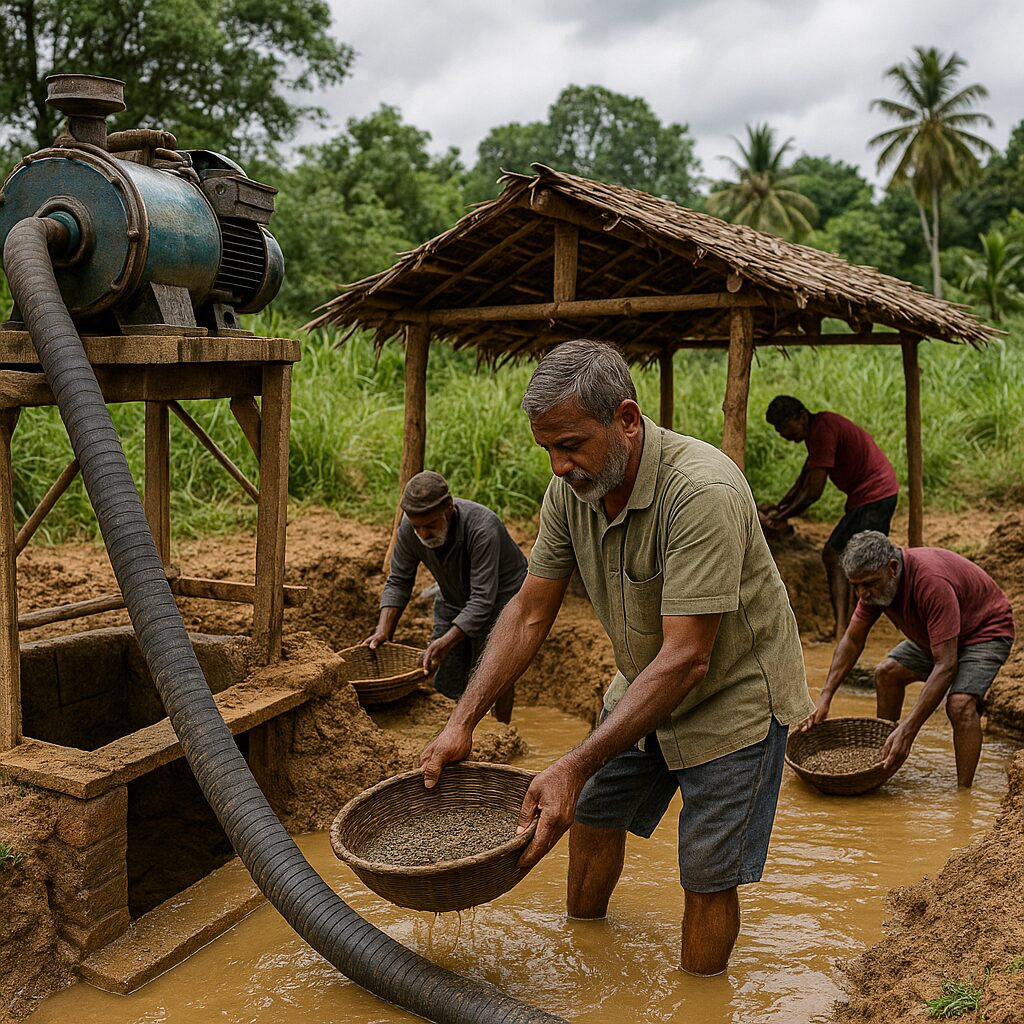
As I moved farther from the traditional pits of Ratnapura, the landscape began to change. The narrow dirt paths gave way to broader roads, and the distant hum of machines replaced the rhythmic creak of hand pulleys. It was a glimpse into a new chapter of the Sri Lanka sapphire mines — one where centuries-old traditions meet the demands of a modern gem industry.
From Hand Tools to Hydraulic Power
In districts like Elahera and Kataragama, I saw how mining has evolved over the past few decades. Here, larger companies operate under government licenses, using controlled mechanization to reach deeper gem deposits. Excavators and water pumps have replaced shovels in some areas, allowing miners to process greater volumes of gravel with less physical strain.
Standing beside a mechanized site for the first time felt both fascinating and unsettling. The machines roared, the ground trembled, and muddy water rushed through large sluice boxes designed to separate heavier gem fragments. Efficiency had clearly increased — but so had the stakes. Each mechanical movement disturbed layers of soil that had lain untouched for ages. Watching it, I couldn’t help thinking of the quiet grace of the older miners and their deliberate pace.
Yet, modernization isn’t the enemy of tradition. Many Sri Lankan operators are learning to balance technology with environmental awareness. Hydraulic pumps are often powered by clean energy sources, and mechanized washing systems now recycle water instead of draining rivers. It’s not perfect, but it’s progress — and in today’s gemstone market, ethical practices have become just as valuable as the stones themselves.
The Role of Regulation and the NGJA
Sri Lanka’s gemstone industry operates under the careful supervision of the National Gem and Jewellery Authority (NGJA), which monitors every stage from exploration to export. Before a company begins digging, it must apply for a mining license that defines the exact size, depth, and duration of the project. Officials periodically visit active sites to ensure miners follow safety and reclamation standards.
During one visit to a licensed mine near Nivithigala, a government inspector explained, “We allow technology, but not exploitation. Every site must return to green once the mining ends.” True to his words, many companies are required to refill pits, plant trees, and restore water channels before they can receive new licenses. The goal is clear — to ensure that the Sri Lanka sapphire mines remain a renewable heritage, not a fading memory. If you want to understand how fair pricing connects to ethical sourcing, see my Buying Sri Lankan Sapphires: A Complete Price & Authenticity Guide for Gem Lovers.
Ethical Sourcing: The New Gold Standard
In today’s global market, transparency matters. Buyers and jewelers from around the world increasingly ask where and how their sapphires are mined. They want assurance that no one is harmed, no rivers are poisoned, and no forests are destroyed for the sake of luxury. Sri Lanka has embraced this demand, becoming one of the few gem-producing nations with a strong ethical framework rooted in both law and culture.
Most Sri Lankan sapphires are mined by small-scale, community-based partnerships rather than massive corporations. This means profits stay within villages, funding schools, roads, and livelihoods. Fair-trade initiatives and cooperatives now help miners receive fair prices for their finds instead of relying solely on middlemen. These community models are slowly reshaping the image of gem mining — from a risky pursuit of fortune to a sustainable craft supporting families across generations.
Women in the Sapphire Trade
Another encouraging change I noticed is the growing presence of women. Traditionally, mining was considered men’s work, but today women participate in sorting, evaluation, and even ownership. In Ratnapura’s gem markets, it’s common to see women examining gravel trays under sunlight, their keen eyes spotting what others might miss. This quiet revolution adds a layer of inclusivity and empowerment that strengthens both the economy and the social fabric.
One woman I met, Nadeesha, owned a small mine with her husband. “It’s not just his dream,” she said proudly. “It’s ours.” Her words captured the evolving spirit of the industry — equal parts tradition and transformation.
The Environmental Balancing Act
Even with regulation and awareness, challenges remain. Erosion, water contamination, and deforestation are constant risks if pits are left open or rivers are over-used. But compared with many mining nations, Sri Lanka stands out for its willingness to self-correct. Community groups often step in to restore abandoned sites, and local schools organize tree-planting drives to rehabilitate mined lands.
Some companies also invest in eco-monitoring systems that track water purity and soil stability. These modern safeguards ensure that the story of the Sri Lanka sapphire mines isn’t one of extraction alone — but of stewardship.
Harmony Between Past and Present
What struck me most was how seamlessly old and new coexist. In one valley, In one valley, I watched a mechanical pump draining a shaft while a group of older miners nearby washed gravel by hand. There was no tension between them — only mutual respect. One relied on the strength of technology; the other trusted the patience of tradition. Both understood that sapphires reveal themselves only to those who treat the earth kindly.
This balance between innovation and integrity is what keeps Sri Lanka’s gemstone legacy alive. The nation has managed to modernize without losing its soul — proving that progress and preservation can, in fact, shine together.
Top Sapphire Mining Regions in Sri Lanka

Every sapphire carries the fingerprint of the land it was born in. The hue, clarity, and brilliance all trace back to a particular valley, river, or mountain slope. When I began traveling across the Sri Lanka sapphire mines, I discovered that each region has its own rhythm — a balance between geology and human character that makes its gems unique.
1. Ratnapura – The Timeless Gem Valley
If Sri Lanka were a crown, Ratnapura would be the central jewel. This lush basin remains the country’s most productive mining district and has supplied sapphires to royal families for centuries. The soil here is deep red, enriched by ancient river sediments that carry traces of corundum.
Walking through the outskirts of Kuruwita or Pelmadulla, I could see rows of bamboo scaffolds and pulley ropes stretching like ribs of a sleeping beast. The people of Ratnapura still depend on community-run pits, where ten or twelve miners share both risk and reward. Many local gem cutters specialize in brilliant-step faceting, known for enhancing a sapphire’s luminous body color.
Beyond mining, Ratnapura hums with small polishing workshops and gem museums. When sunlight filters through the shop windows, it catches the sparkle of dozens of stones — a living reminder that this valley’s identity is carved from the earth itself.
2. Elahera – The Frontier of Modern Mining
A few hours north of Kandy lies Elahera, an area famed for producing some of Sri Lanka’s most vivid blue sapphires. Unlike Ratnapura’s soft alluvial soils, Elahera’s terrain is more rugged, marked by lateritic clay and rocky hills. Here, both mechanized and traditional techniques coexist.
When I arrived, the air buzzed with the sound of hydraulic pumps and the chatter of miners trading stories over lunch. The NGJA has carefully zoned Elahera for controlled mechanization, allowing miners to dig deeper while preserving forest corridors and waterways. The gems from this district often show exceptional clarity and a bright, electric hue — qualities that make them prized among international collectors.
What fascinated me most was how technology hadn’t erased humanity here. The miners still pause before sunrise to light incense sticks near a small shrine, asking for safe hands and honest finds. Even surrounded by engines, spirituality remains part of the landscape.
3. Balangoda – The Mountain Miner’s Domain
Perched high in the Sabaragamuwa hills, Balangoda feels different — cooler, quieter, almost contemplative. Mist curls through pine groves, and streams carve silver lines through the valleys. Mining here is tougher because of steep slopes and rocky layers, yet the yields are often exquisite.
In Balangoda’s narrow ravines, miners dig horizontal tunnels rather than vertical pits, following gem-bearing veins like ancient prospectors. They work in near silence, guided by the sound of trickling water. The sapphires from this region tend to have softer tones — cornflower blues and subtle pastels — stones that feel almost poetic.
What stays with me from Balangoda isn’t the gems themselves but the calm determination of the people. Their patience mirrors the mountains they live in — unyielding, serene, and quietly strong.
4. Kataragama – Where Faith Meets the Earth
Farther south, near the sacred town of Kataragama, lies another pocket of gem-rich land. Pilgrims come here year-round to visit temples dedicated to Lord Murugan and the Buddha, while just beyond the shrines, miners dig in sandy plains veined with sapphire gravels.
The work begins early, often accompanied by chants from nearby shrines carried on the wind. Many miners here consider their work a form of devotion — an offering of labor rather than mere livelihood. The sapphires from Kataragama are typically light blue or greenish — colors that mirror the calm of the region’s rivers and forests.
I remember one miner telling me, “Every gem we find is a blessing, not a possession.” It summed up the spirit of this sacred mining zone — where spirituality softens the rough edges of industry.
While not as famous as Ratnapura or Elahera, Nivithigala quietly powers much of Sri Lanka’s gem trade. Nestled in the southwestern hills, its soil is a patchwork of rubber estates, paddy fields, and family-run mines. What makes Nivithigala remarkable is its cooperative spirit: neighbors often pool land and share profits, turning mining into a community affair.
Here, I found miners using a blend of hand-dug pits and shallow river mining. The stones are smaller but consistently clean and bright. Traders say Nivithigala sapphires carry a certain warmth — not just in color but in reputation — because they’re born from honest labor and fair partnerships.
As I left the village, I looked back at the hills glowing gold in the afternoon light. There were no grand machines, no tourists, no noise — just quiet perseverance. In that stillness, I understood why Sri Lanka’s gemstone legacy endures: it’s sustained not by fortune seekers, but by families who see the earth as kin.
Explore Top Sapphire Mining Regions in Sri Lanka on Google maps
Gem Auctions & Local Markets

If the sapphire mines are the heart of Sri Lanka’s gem story, then the markets are its pulse. The energy that begins deep underground finds its way to open-air stalls, gem houses, and auction rooms that buzz with voices, light, and expectation. To walk through these markets is to witness the transformation of mud into magic — a journey that connects miners, traders, and travelers from every corner of the world.
The Morning Market in Ratnapura
My first experience of a gem auction came early one morning in Ratnapura. The sun had barely risen, but the narrow lanes near the old clock tower were already alive with people. Miners arrived carrying small pouches wrapped in cloth, each containing their finds from the week. Buyers from Colombo, Bangkok, and even London leaned over tables, magnifiers in hand, inspecting every sparkle.
Unlike the formal auctions held abroad, Ratnapura’s market feels intimate and human. There are no loud calls or flashing screens — just quiet negotiations whispered over cups of tea. A miner might open a folded paper to reveal a small blue stone, and within seconds, five heads gather to see it. The trader’s eye is quick, trained by years of experience. A nod, a handshake, and sometimes a small smile seal the deal.
It amazed me how fast the rhythm moved. In less than an hour, hundreds of stones changed hands, their journeys extending from muddy pits to polished showrooms across the world. Every trade carried a story — a miner’s patience, a cutter’s skill, and a buyer’s intuition.
Auctions and Licensed Sales Centers
Beyond these informal markets, Sri Lanka operates official auction systems regulated by the National Gem and Jewellery Authority (NGJA). Licensed gem dealers gather in government-approved centers, where transactions are documented, taxed, and sometimes even certified on the spot. This transparency has earned Sri Lanka a global reputation for fair trading.
During one of my visits to a licensed sale in Pelmadulla, I watched government officers meticulously log each sapphire sold. Buyers from India and Thailand compared stones under fluorescent lamps, testing clarity with handheld spectroscopes. What impressed me most wasn’t the glamour — it was the order. There was a quiet pride in how ethically the Sri Lanka sapphire mines fed this trade, ensuring every gem’s origin could be traced with confidence.
These official auctions also provide an important safety net for small-scale miners. Instead of relying on middlemen, they can present their stones directly to certified buyers and receive fair market prices. It’s a simple idea with enormous impact — it protects livelihoods, encourages legal mining, and helps the industry grow with integrity.
Gem Shops and Street Traders
Outside the regulated zones, Ratnapura’s streets themselves feel like one endless marketplace. Small gem shops line the roads, their windows shimmering with blues, yellows, and greens. Inside, traders carefully open boxes filled with stones of every size and shade. Most welcome visitors warmly, offering demonstrations of how raw sapphires are cut, polished, and graded.
Not every deal here is for professionals — tourists, too, come to browse. Some shops offer guided tours where travelers can watch artisans transform rough stones into dazzling jewelry. The process is mesmerizing: a rough sapphire is placed on a small dop stick, shaped against a spinning wheel, and then polished until its fire blooms. Watching that transformation feels almost poetic — a visible metaphor for the island itself, where simplicity hides brilliance beneath the surface.
Yet amid the beauty, caution is wise. Genuine traders are transparent, but imitation stones and exaggerated claims do exist. It’s always best to buy from licensed dealers or those affiliated with the NGJA. Most reputable sellers will provide a gemstone report confirming authenticity, weight, and origin. Many travelers head from the gem markets to reputable showrooms—discover my hand-picked Best Places to Buy Sapphires in Sri Lanka for trusted dealers and authentic experiences.
The Global Connection
What’s remarkable about Sri Lanka’s gem market is how deeply it’s woven into the global jewelry trade. Buyers from Europe, the Middle East, and East Asia all converge here, drawn by trust built over centuries. The Sri Lanka sapphire mines are known not only for their quality but also for ethical mining standards, which give these stones unmatched credibility in the luxury world.
During one conversation with a Thai buyer, he told me, “When we say ‘Ceylon sapphire,’ the customer smiles before we even show the stone.” That single line explained everything — Sri Lanka isn’t just a producer; it’s a brand rooted in integrity.
A Living Heritage of Trade
By evening, the market streets grow quiet again. The tables are cleared, the lamps turned off, and miners head home — some with pockets full, others empty-handed. Yet even those who made no sale walk away with hope. Because here, hope itself is currency. Tomorrow might bring another stone, another chance, another story.
As I left Ratnapura’s gem market under a soft drizzle, I realized this trade is not about wealth alone. It’s about continuity — the seamless bridge between earth and commerce, labor and artistry, the miner’s calloused hands and the jeweler’s polished showcase. That harmony is what keeps the spirit of Sri Lanka’s sapphire trade alive, generation after generation.
Responsible Tourism: Visiting Mines Safely

When I first visited one of the Sri Lanka sapphire mines open to tourists near Ratnapura, the guide handed me a small hard hat and said with a smile, “You don’t need to dig — just feel the earth.” That line stayed with me. It captured the essence of visiting these places: not to intrude, but to understand. Responsible gem tourism isn’t about watching people work; it’s about connecting with a tradition that has shaped the island’s culture, environment, and economy for centuries.
Such a great experience to see how they mine the stones and its very personal with no expectations to purchase items after.
See more reviews on Tripadvisor
Why Responsible Travel Matters
The sapphire industry supports thousands of Sri Lankan families — miners, traders, cutters, and craftsmen — yet the work remains delicate. Pits can collapse, machinery can injure, and the environment can easily suffer from overuse. Tourists who visit the mining regions carry both opportunity and responsibility. Their curiosity can bring jobs and awareness, but it can also disturb fragile ecosystems or local privacy if not handled with care.
That’s why the Sri Lankan government, alongside the National Gem and Jewellery Authority (NGJA), encourages structured mine visits under local supervision. These tours allow travelers to see the process safely while ensuring that miners are compensated and sites remain undamaged.
Visiting a Mine: What to Expect
Tours typically begin with a short introduction about the geology of the region — how millions of years of erosion and river movement concentrated sapphire-rich gravel. Then, visitors are guided to small demonstration pits. The miners are often proud to show their craft: lowering buckets, hauling up gravel, and washing the illam to reveal glimmers of stone.
The sight is humbling. You see hands calloused by years of labor, movements perfected through repetition, and a deep sense of respect for the land. I remember leaning over a washing pan one afternoon and catching sight of a faint blue glimmer. The miner laughed softly. “Not a sapphire — but close. Maybe next one.” His patience said everything about this profession.
For safety, visitors must stay behind marked barriers and always follow the guide’s instructions. Most mines are compact but can be slippery after rain, so closed shoes are a must. Helmets are often provided, though the demonstration areas rarely go deep.
Best gem store in Colombo. Best service and most beautiful jewels! Very dedicated to the customers’ needs 🙏🙏
See more reviews on Tripadvisor
Respecting People and Culture
It’s easy to forget that mining sites are workplaces, not performances. Before taking photos, always ask permission. Many miners prefer not to be photographed while working, and respecting that wish shows cultural sensitivity. Avoid interrupting their rhythm with too many questions during labor — guides are usually happy to explain everything afterward.
Another way to show respect is through small gestures of appreciation. Buying a souvenir or donating to a local cooperative supports the community far more than a tip offered in haste. Remember, for many of these families, mining is a heritage as much as a livelihood.
Cultural respect extends beyond the pits. In mining regions like Ratnapura or Kataragama, shrines and temples are often nearby. Dress modestly, remove hats when entering sacred spaces, and follow local customs such as offering flowers or lighting lamps if invited. These small actions make travelers feel like participants rather than observers.
Ethical Shopping for Visitors
After visiting the mines, most tourists head into town to browse gem shops. This is where responsible tourism meets consumer choice. Always choose stores licensed by the NGJA — they display certificates and often have clear signage in English. Reputable shops will explain the origin of each stone and may even show photos of the mine it came from.
Ask for authenticity reports if you plan to purchase. Many dealers provide gemological certificates that include refractive index, carat weight, and origin. If a shop hesitates to show documentation, it’s best to walk away politely. Buying ethically ensures that your souvenir contributes to sustainable trade rather than exploitation.
Sustainability Beyond the Visit
True responsibility doesn’t end when the tour does. Travelers can help preserve Sri Lanka’s gemstone heritage by spreading awareness about ethical sourcing, supporting eco-conscious travel agencies, and sharing positive experiences that highlight cultural respect. Some NGOs and local schools even run tree-planting programs to restore land around mined areas — a meaningful activity visitors can join.
One of my most memorable experiences was helping plant young saplings near a reclaimed pit. The miners who joined us smiled as they covered the roots with soil. “Maybe these trees will shade our sons when they dig one day,” one said. It reminded me that sustainability isn’t an abstract goal here — it’s a promise to future generations.
A Journey of Understanding

Visiting the Sri Lanka sapphire mines isn’t about chasing glamour. It’s about humility — realizing how much effort, faith, and time go into uncovering a single stone. These tours change the way you see jewelry forever. A sapphire ring stops being just an ornament; it becomes a story of land, hands, and hope.
Responsible tourism transforms travelers into allies — people who help protect a legacy rather than consume it. And in a world that often forgets where beauty begins, Sri Lanka’s mines remind us that true luxury lies not in possession but in respect.
Traveler’s Takeaway + Personal Reflection
When I look back on my journey through the Sri Lanka sapphire mines, what stays with me isn’t just the shimmer of the stones — it’s the heartbeat of the land and the people who live by it. I remember the smell of wet earth after rain, the rhythm of pulleys creaking in the morning light, and the laughter of miners as they shared tea near muddy pits. Each of those moments told me that this industry, often seen as glitter and glamour from afar, is really built on perseverance, patience, and profound respect for nature.
The Deeper Meaning of a Sapphire
Before I came to Ratnapura, I thought sapphires were just symbols of beauty — coveted gems that sparkled on royal crowns and engagement rings. But here, their meaning deepened. Every sapphire represents countless hours of unseen labor, generations of knowledge, and a spiritual bond between humans and the earth.
In the eyes of a miner, a sapphire isn’t only a commodity; it’s proof that nature rewards harmony, not haste. I’ve met men who dig under scorching sun and women who sift through river sand by hand, all driven not by greed but by pride. They believe that the earth gives only what one deserves — an ancient philosophy that quietly guides every shovel of soil they turn.
That humility sets the Sri Lanka sapphire mines apart from much of the modern world. Here, mining is not domination but dialogue. It’s a conversation between land and people, faith and patience, work and reward.
When Heritage Meets Hope
As I traveled from the crowded streets of Ratnapura to the misty slopes of Balangoda and the quiet plains of Kataragama, I began to see how this gem culture connects the entire island. It’s not confined to pits and gravel; it extends to temples, families, and markets — all tied together by a shared rhythm of endurance.
Even in mechanized sites, I sensed that old-world discipline: the prayer whispered before starting a machine, the lamp lit before lowering a shaft. Modernization has entered these valleys, yes, but it hasn’t erased their soul. The miners’ respect for the environment and their willingness to adapt to sustainable practices show that progress here doesn’t mean forgetting the past — it means refining it.
What I found inspiring was how the younger generation views this legacy. Many educated youth now return to their hometowns after studying geology or gemology abroad. They bring scientific precision to ancient methods, proving that Sri Lanka’s sapphire heritage can continue responsibly in a changing world.
Lessons from the Earth

Standing beside a washing pan one afternoon, I watched as sunlight struck the water’s surface and turned ordinary gravel into a mosaic of colors. It struck me then: beauty doesn’t appear suddenly — it reveals itself slowly, through effort and observation. That’s the lesson these mines teach better than any classroom ever could.
It’s the same lesson travelers take home — patience, appreciation, and the quiet understanding that not all riches are visible. You begin to see beauty in rawness, in mud-streaked hands, in sweat that glistens more genuinely than any gemstone.
The people of these valleys have mastered the art of finding grace in difficulty. They wake each morning to a routine as old as their ancestors — digging, washing, sorting — with faith that something extraordinary may emerge. Whether it does or not, they end the day with gratitude. That kind of contentment is its own kind of treasure.
A Personal Connection
When I left Ratnapura, I carried no gemstone in my pocket, but I carried a story in my heart. A miner’s laughter, a woman’s steady gaze as she examined gravel, a child running barefoot through puddles near the pits — they all became part of how I now see Sri Lanka.
The Sri Lanka sapphire mines are more than a destination. They are living museums of human endurance and artistry. To visit them is to touch the island’s soul — a reminder that value doesn’t always shine from a showcase; sometimes, it glows quietly in the people who keep a tradition alive.
What Every Traveler Should Remember
If you plan to visit these gem valleys, come not as a collector but as a listener. Let the land speak. Watch how patience carves beauty, how respect turns labor into art. And when you leave, remember that every sapphire you see in a store window once rested deep within this earth — cradled by time, uncovered by hands that believe in grace.
Sri Lanka’s sapphire country teaches us something precious: that the most brilliant things in life are born from humility, cooperation, and care. And in a world chasing instant glitter, that quiet truth might just be the rarest gem of all.
Final Thoughts & Personal Favorites
As I reflect on everything I’ve seen in the Sri Lanka sapphire mines, I realize this journey wasn’t simply about gemstones — it was about discovering the soul of a nation. These mines, scattered across valleys and riverbeds, are more than economic lifelines; they are living stories that link ancient craftsmanship with modern conscience. Every miner, every stone, and every glimmer of light beneath the soil forms part of a narrative that still unfolds, quietly, day after day. If you’d like to dive deeper into the history, symbolism, and enduring allure of these precious stones, don’t miss my full guide Sri Lankan Sapphires: The Ultimate Guide to Ceylon’s Precious Gems — the cornerstone article that explores how these gems shaped Sri Lanka’s identity and global reputation.
The Living Connection Between Earth and People
Sri Lanka’s relationship with sapphires runs deeper than trade. For generations, mining has shaped communities, created friendships, and passed down knowledge from parent to child. It’s easy to be captivated by the gemstones themselves, but what touched me most were the faces of the miners — their hands rough from work, their smiles full of dignity.
Standing in the humid air of Ratnapura, I realized that the true sparkle doesn’t come from the stones but from the people who bring them to light. Their patience, respect for the environment, and faith in what they do make every gem a symbol of integrity. That spirit of balance between labor and love is something you can feel in every corner of the Sri Lanka sapphire mines.
A Journey of Beauty and Responsibility
The deeper I ventured into this world, the clearer it became that sapphire mining in Sri Lanka is as much about ethics as it is about excellence. The miners know that every pit they dig affects the land that nourishes them. This awareness has shaped a unique model — one where progress walks hand in hand with preservation.
Unlike in many countries, here I found no vast scars of open-pit destruction. Instead, I saw reclaimed lands, tree-planting efforts, and water channels restored after mining was done. It reminded me that sustainable beauty isn’t a dream — it’s already happening in these hills, led by people who still believe in giving back more than they take.
Personal Favorites from My Journey
If I had to choose one memory that defines the heart of Sri Lanka’s gem country, it would be the moment I stood by a small river near Pelmadulla. A miner named Sunil was washing gravel in the afternoon light when a faint glimmer caught his eye. He reached down, lifted a tiny pale-blue stone, and held it out to me. “Maybe not the finest,” he said, “but it’s honest work.” That humility, that quiet pride, felt like the essence of this place.
Another moment came later in Balangoda, as mist rolled over the mountains and the sound of temple bells drifted through the air. I thought about how these same hills had been mined for centuries, yet still felt sacred, untouched in spirit. It’s in places like these that the legacy of Sri Lanka’s sapphire lands truly lives — not just in the gems, but in the harmony between people and earth.
What This Journey Teaches Us
Traveling through the sapphire mines taught me something essential: beauty and responsibility can coexist. The world often divides progress and preservation, yet Sri Lanka quietly proves that both can thrive together. Its miners honor the soil that feeds them; its traders uphold fairness and transparency; its visitors, if respectful, can help sustain a tradition older than history itself.
Every sapphire carries within it the memory of water, sunlight, and human patience. When set in a ring or pendant, that stone still whispers the story of the valley it came from — a story of endurance, craftsmanship, and hope. And that’s what makes Sri Lankan sapphires not just precious, but profoundly meaningful.
Closing Reflection
When I left the gem valleys, I took nothing but gratitude. I understood that Sri Lanka’s true wealth isn’t hidden beneath the earth — it lives above it, in the people who mine, polish, and protect these treasures with care. If you ever visit, go not just to see sapphires, but to feel the heartbeat of this island — a rhythm of work, faith, and wonder that continues to shine through every facet of blue.
The Sri Lanka sapphire mines are not just the source of the world’s most luminous gems; they are a reminder that when humans work with respect for nature, the earth responds with grace. That balance — between effort and ethics, between tradition and tomorrow — is the real gem of this story.
Frequently Asked Questions about Sri Lanka Sapphire Mines
💎 About the Mines and Locations
Most of Sri Lanka’s sapphires come from the southern and central regions — especially Ratnapura, the famed City of Gems. Other key areas include Elahera, Balangoda, Kataragama, and Nivithigala. These regions hold ancient alluvial deposits of gem-bearing gravel called illam, created by rivers over millions of years.
Sri Lanka’s gem fields produce over 70 varieties of gemstones. Alongside blue sapphires, you’ll find rubies, yellow sapphires, alexandrite, spinel, topaz, moonstone, and more — a testament to the island’s extraordinary mineral diversity.
🧭 Visiting and Responsible Tourism
Yes. Guided tours around Ratnapura and Pelmadulla let visitors safely observe small-scale mining under National Gem and Jewellery Authority (NGJA) supervision. You’ll see pit-digging, washing, and sorting, but visitors must follow safety rules and remain behind marked areas.
Visit during the dry seasons — December to April or June to September — when mining is active and travel conditions are comfortable. Many mines close during the monsoons for safety.
🌱 Ethics, Sustainability & Trade
Yes. The industry follows strict NGJA guidelines on licensing, safety, and land rehabilitation. Most mines are community-run, using water-recycling systems and re-planting programs that keep environmental impact low while sustaining local livelihoods.
Purchase only from licensed dealers registered with the NGJA. Reputable sellers provide gemstone certificates verifying authenticity, origin, and carat weight. Ask for NGJA or GIA documentation and avoid unverified street vendors.
🔷 Global Reputation and Quality
Sri Lanka’s “Ceylon sapphires” are admired for their vivid color, clarity, and natural brilliance. Many require little or no heat treatment. Centuries of skilled cutting and transparent trade practices have made “Ceylon sapphire” a trusted global hallmark of ethical beauty.


